
Author: Kevin

New, SEO, SEO-GMB

Local SEO 2021: Introduction to Google My Business (GMB)

April 16, 2021

Google My Business (GMB)
Google My BusinessIn this blog we’ll talk about finding, claiming, verifying your local business, as well as different best practices to improve your local business ranking on Google.

Google My Business lets you manage how your local business appears across Google products, like Google Maps and Google Search. If you operate a business that serves customers at a specific location, or you serve customers within a designated service area, Google My Business helps people find you. Verified businesses on Google are twice as likely to be perceived as reputable by users.

When somebody searches for a business near their location, they will find local results in various Google properties such as Google Maps and Google Search. For instance, you can find local results by searching for “Chinese restaurant” on your mobile phone. Google tries to show you the most  relevant nearby restaurants that fit your specific query.

To establish a presence and/or improve your business’ local ranking on Google, use Google My Business to claim and update your business information.

Find Your Business on Google

If your Business Profile doesn’t show up on Google Maps, Search, or other Google properties, you will need to take additional steps. Google My Business offers various ways to try to fix this.

Your business isn’t verified.

The business information you provide to Google My Business won’t be eligible to display on Google until you verify your business.

Your business shows up on Google Maps but doesn’t always appear in search results.

Your business information’s placement in search will vary. For the best possible ranking, make sure that your business information is correct, comprehensive, and up to date.

You recently added or edited your business information.

Google’s search results are based on algorithms that take a wide range of factors into account. When you edit your business information, it might change the search results, and edits may take up to 3 days to appear.

If you search for your business by name, you should still be able to find it on Google Maps.

Your business information doesn’t comply with Google’s guidelines.

Follow Google’s guidelines to help avoid common problems, like:

  • Unexpected changes to your information
  • The removal of your business information from Google

If you violate the guidelines, you’ll get a message in your Google My Business account to let you know that your business has been disabled or suspended. Once you’re sure that your business follows these guidelines, contact us to help get your business information published again.

Find Current Business Information on Google

  1. Sign in to Google My Business.
  2. If you have multiple locations, open the location you want to manage.
  3. In the menu, on the left, click Info.
  4. Under “Your business is live on Google,” you’ll find links to your profile on Google Search or Google Maps. Click any of these links to determine how your business appears on the respective service.

If you need assistance, you can also reach out to experts in the Google My Business Community.

Ways to Improve Your Business’s Local Ranking on Google

Update your Business Information for Better Search Visibility

If your business doesn’t show up for relevant local searches in your area, check to make sure that your business information in Google My Business is accurate, complete, and engaging.

Enter Complete Data

Local results favor the most relevant results for each search. Businesses with complete and accurate information are easier to match with the right searches. It is very important to make sure that you keep your business information up to date if/when an aspect of your business that can affect customers changes.

Be sure to enter complete business information in Google My Business – what you do, where you are, and when your business is open. Important information includes, but is not limited to, your business’:

  • Physical address
  • Phone number
  • Category
  • Attributes

Verify Your Location(s)

Verify your business location(s) to improve the likelihood of showing up in local search results on Google products, like Google Maps and Google Search.

Maintain Accurate Business Hours

Update your business hours regularly, including when you open and close, and special hours for holidays and events. Accurate hours allow potential customers to know when you’re available and gives them confidence that your business will be open when they arrive.

Manage & Respond To Reviews

It is important to respond to reviews that users leave about your business. When you reply to reviews, it sends the message that you value your customers and their feedback. High-quality, positive reviews from your customers can improve your business visibility and increase the likelihood that a shopper will visit your location.

Add Photos

To showcase and promote your goods and/or services, as well as tell the story of your business, add photos to your Business Profile. Accurate and appealing pictures may also show prospective shoppers that your business offers what they’re searching for.

How Google Determines Local Ranking

Local search results are based primarily on relevance, distance, and prominence. A combination of these factors helps Google find the best match for  search queries. For example, Google’s algorithms may conclude that a business that’s located farther from your location is more likely to have what you’re looking for than a business that’s nearby, consequently ranking it higher in local search results.

Relevance

Relevance refers to how closely a local Business Profile matches what someone is searching for. By adding complete and detailed business information, Google will be able to better understand your business and match your profile to relevant searches.

Distance

Distance considers how far each potential search result is from the location where the search query is made. If a user doesn’t specify a location in their search, Google calculates the distance based available location data.

Prominence

Prominence refers to how well known a business is. Some places are more prominent in the offline world, and Google’s search results try to reflect this in local search rankings. Examples include famous museums, landmark hotels, or well-known store brands, all of which are likely to be prominent in local search results.

Prominence is also based on information that Google has about a business, from the web, such as links, articles, and directories. Google review counts and review scores also factor into local search rankings. More reviews and positive ratings will help to improve your business’ local ranking. Your business’ position in organic web search results is also a factor, so search engine optimization (SEO) best practices should be followed.

For additional information about claiming, verifying or updating your Google My Business listing, help is available at Google My Business Help.

_________

For more information on ways to amplify and elevate your company’s search engine visibility, contact our Digital Marketing team.

We can walk you through the entire SEO process and pride ourselves on being responsive when answering any questions.

New, SEO

SEO 2021: Google Search E-A-T Principle & YMYL

March 15, 2021

Google Search E-A-T Principle

What is E-A-T?

E-A-T stands for “Expertise, Authoritativeness, Trustworthiness.”

What is Google E-A-T?

Each of these terms represent a measurement of the degree to which a business is considered a leader in its field, regardless of the industry or niche that they may fall into.

Expertise” – The Oxford English Dictionary defines “expertise” as “Expert skill or knowledge in a particular field.” If you offer a service or product that you have deep knowledge about, you could be classified as an expert in that field, especially if you can demonstrate that your knowledge level matches or exceeds that of your competition.

Authoritativeness” – Authority, or “authoritativeness” — is a person or website whose content can “be trusted as being accurate or true and reliable.” Google is constantly analyzing your brand, your website, and your content to determine if it’s content is expertly written as well as the leading authority or authoritative source available.

Trustworthiness” – Trustworthiness is defined as “The ability to be relied on as honest or truthful.“ Creating a lot of content on the internet is not equivalent to being trustworthy. Google measures trust in a website based upon the backlinks it detects from other domains. The higher the trust of the “linked from” domain, the more trust is is attributed to the “linked to” domain. Google has expanded this over the past few years and is now measuring the trustworthiness of a brand or website using the same types of factors as a real person would; trust someone who has repeatedly demonstrated themselves to be trustworthy.

.

Why is E-A-T So Important for Your Web Pages?

Google states that E-A-T is among the top 3 considerations for Page Quality. Essentially, E-A-T determines a website’s value. Quality raters keep E-A-T in mind when judging how good a site or page provides what they need. They look to see if they’re getting a good online experience and if the content meets their standards. If the raters feel like a user would feel comfortable reading, sharing, and recommending the content, that earns the site a high level of E-A-T.

Think of E-A-T as the reason why users would choose your site over your competition’s. E-A-T could have a direct impact on how Google receives — and ultimately ranks — your website.

A great resource for advice on the considerations that Google takes into account when determining content quality is their search quality rater guidelines.

Make Expertise and Authoritativeness Clear

Per Google’s SEO guidelines, “Expertise and authoritativeness of a site increases its quality. Be sure that content on your site is created or edited by people with expertise in the topic. For example, providing expert or experienced sources can help users understand articles’ expertise. Representing well-established consensus in pages on scientific topics is a good practice if such consensus exists.”

Act in a way that Cultivates User Trust

Users feel comfortable visiting your site if they feel that it’s trustworthy. A site with a good reputation is trustworthy. Cultivate a reputation for expertise and trustworthiness in a specific area. Provide information about who publishes your site, provides the content, and its goals. Shopping and other financial transaction websites should have clear and satisfying customer service information to help users resolve issues. News sites should provide clear information about who is responsible for the content.

Using appropriate technologies is also important. If a shopping checkout page doesn’t have a secure connection, users cannot trust the site.

.

“Your Money or Your Life” or YMYL

So how does E-A-T affect visitors to your site?

E-A-T is closely related to what Google calls “Your Money or Your Life” (YMYL) pages.

YMYL is an acronym for “Your Money or Your Life”. YMYL content is content that can directly impact a reader’s health, finances and/or safety.

Google YMYL - Your Money Your Life

High-ranking YMYL pages will show a high level of E-A-T. This is because the safer a user feels while visiting a page, and the more relevant the content is to their search query, the more it will satisfy E-A-T. Sites that are offering genuinely helpful advice or a solution to a problem will meet E-A-T standards more readily than sites that try to game Google search.

Since E-A-T is applicable at both the page and site-level, you need to make sure that every part of your website is doing its best to meet Google’s requirements. If your pages qualify as YMYL pages, this is even more crucial.

Google says that a page or site found lacking in E-A-T is a “sufficient reason to give a page a Low-quality rating.” So if you aren’t an expert, an authority, or trustworthy, your site page could be considered low quality.


E-A-T / YMYL Questions To Ask (Google Guidelines)

  • Does the content present information in a way that makes you want to trust it, such as clear sourcing, evidence of the expertise involved, background about the author or the site that publishes it, such as through links to an author page or a site’s About page?
  • If you researched the site producing the content, would you come away with an impression that it is well-trusted or widely-recognized as an authority on its topic?
  • Is this content written by an expert or enthusiast who demonstrably knows the topic well?
  • Is the content free from easily-verified factual errors?
  • Would you feel comfortable trusting this content for issues relating to your money or your life?

.

Think of E-A-T , within the context of YMYL if applicable, as the reason why users would choose your website over your competition’s. Expertise, authoritativeness and  trustworthiness will directly impact on how Google perceives and ranks your website.

_________

For more information on ways to amplify and elevate your company’s search engine visibility, contact our Digital Marketing team.

We can walk you through the entire SEO process and pride ourselves on being responsive when answering any questions.

New, SEO

SEO 2021: Search Engine Optimization and Core Web Vitals

March 8, 2021

Search Engine Optimization and Core Web Vitals

SEO

SEO and Core Web Vitals go hand in hand in improving the quality and quantity of the traffic a website gets from organic search results. There are a number of ways that a website can achieve this, differing slightly depending on the search engine, but for the purpose of this discussion, we will be focusing on Google. Generally, the primary SEO aspects of the most important runner-up search engines (Bing & Yahoo!) are the same:

  • Create Relevant Content
  • Make the Content Accessible to Search Engines
  • Positive SEO Signals


Users go to search engines to with questions, to find out more, and your web pages might provide the answers that they’re searching for. This entails more than just writing well. When creating relevant content, it’s about picking topics and phrases that are used by your target audience.

If Google can’t understand your content, it’ll be unlikely that your page will be interpreted as relevant and Google will not recommend it. You need to demonstrate why your site’s content is highly relevant by understanding and utilizing the various search engine algorithm signals that are involved in SEO.

There’s a lot at play here. Given that there may be multiple very good and relevant search query results, how can you show that your webpage is particularly relevant and useful in providing the information that users are searching for, right now? This is where Core Web Vitals come into play. Usability plays a major role in today’s search ranking algorithms and SEO. Information is helpful, but there’s much more!

What are the Core Web vitals?

Measuring the quality of user experience has many facets. While some aspects of user experience are site and context specific, there is a common set of signals — “Core Web Vitals” — that is critical to all web experiences. Such core user experience needs include loading experience, interactivity, and visual stability of page content, and combined are the foundation of Google’s 2020-2021 Core Web Vitals.

Core Web Vitals - Overview

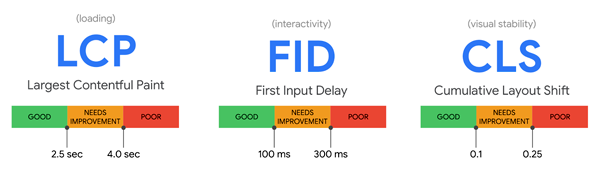
  • Largest Contentful Paint (LCP) measures perceived load speed and marks the point in the page load timeline when the page’s main content has likely loaded.
  • First Input Delay (FID) measures responsiveness and quantifies the experience users feel when trying to first interact with the page.
  • Cumulative Layout Shift (CLS) measures visual stability and quantifies the amount of unexpected layout shift of visible page content.


All of these metrics capture important user-centric outcomes, are field measurable, and have supporting lab diagnostic metric equivalents and tooling. For example, while Largest Contentful Paint is the topline loading metric, it is also highly dependent on First Contentful Paint (FCP) and Time to First Byte (TTFB), which remain critical to monitor and improve.

How do the Core Web Vitals play a role in SEO?

You’ve heard a lot about the Core Web Vitals today already. So this is really just a super short overview to help get you started.

The Core Web Vitals focus on three aspects affecting user experience:

  1. Loading
  2. Interactivity
  3. Stability


When it comes to data sources, Google differentiates between field data and lab test data.

Metrics Gathering

Field Data (used for search)

  • Real User Metrics or RUM data
  • Chrome User Experience Report, or CrUX
  • Based on site’s actual users from prior ~month


Field data, also called Real User Metrics or RUM data, is collected from users over the course of about a month and is based on what they experience when viewing your site. This is a part of the Chrome User Experience Report, or CrUX.

Lab Test Data

  • Approximations based on assumptions of user data
  • Useful for testing and iterative improvements


Lab tests, on the other hand, are generated on demand with testing tools in your browser or on a server using settings that try to approximate what users would see.

For search rankings, field data is used – what your site’s users have experienced over time. This makes the data more representative for your site, taking into account where your users are located and how they access your website.

The Core Web Vitals metrics are then combined with other search signals; this combination is represented as the Page Experience Ranking Factor.

Additional Search Signals include:

  1. Mobile-Friendliness
  2. Safe-Browsing
  3. HTTPS Security
  4. Compliance with Interstitial Guidelines


These have all been around for a while and there’s much written about them so we won’t go into much detail here. These signals are adjusted over time to best reflect good user experience for users. Google generally gives a six month notice before any major signal changes.

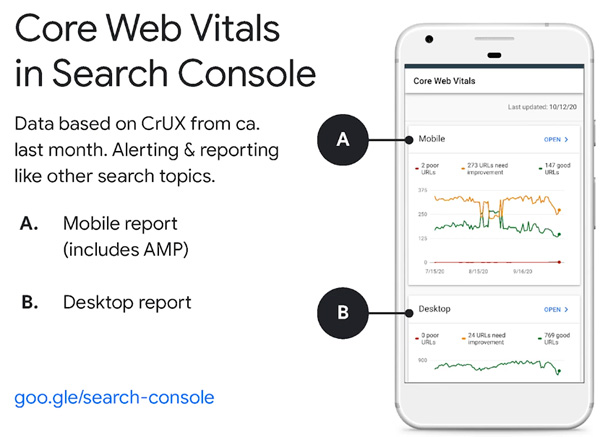
The data is split by mobile and desktop and applied appropriately for respective search rankings. When a mobile page is shown as a separate AMP URL to users, that’s what will be used  and analyzed, i.e., if you’re on a mobile page, the ranking is only affected by mobile data; the same applies for desktop.

To summarize, for search rankings, Google uses a page experience set of metrics. These include a few existing signals as well as the Core Web Vitals. Google tracks these metrics based on what users see and experience, separating the mobile and desktop experiences.

Using Search Console for Google Web Vitals

How can you use the Google Search Console to help track and improve your site’s metrics?

The Google Search Console is a free tool for site owners that gives insights into Google Search for your website. Once you’ve verified ownership of your website and allowed a bit of time for the collection of all the metrics, it’s time to head over to the Core Web Vitals Report.

Using Search Console for Google Web Vitals


In the Core Web Vitals report, you’ll see graphs for mobile and desktop showing how a relevant sample of your site’s pages score. This sampling and the scoring is based on the Chrome user experience report data. That’s the field data collected over time. As a result, any changes that you make on your website will take about a month to be reflected here.

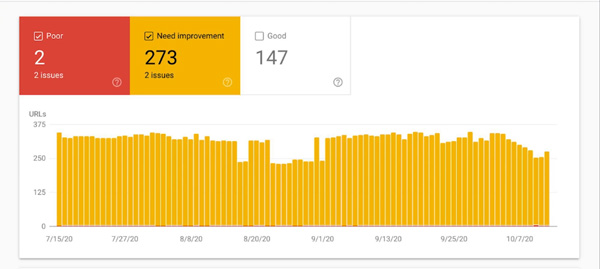
Clicking through to one of these reports, you see a graph of the total number of URLs tracked and can see the individual issues flagged.

Core Web Vitals in Search Console

Core Web Vitals in Search Console


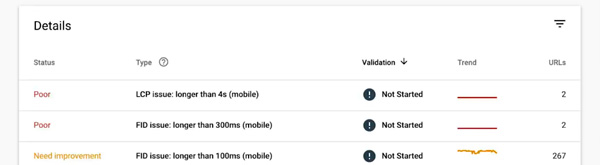
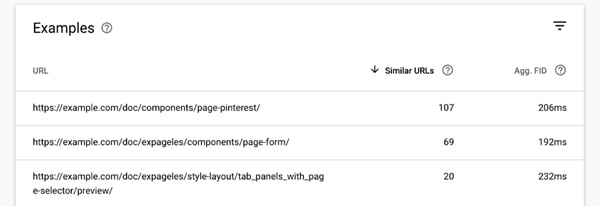
Drilling down, into one of these issues, you’ll see a similar graph on top, with a list of sample URLs for the respective issue type below.

Issue Drill-Down in Search Console

Issue Drill-Down in Search Console


Bear in mind that these search console reports are based on a sampling of field data, consequently not all of your website’s URLs will be listed here. It’s usually useful to focus on the larger issues across both the “poor” and “needs improvement” categories. Google tries to recognize patterns, such as shared templates and group those URLs together; fixing a major issue once can improve large segments of your website.

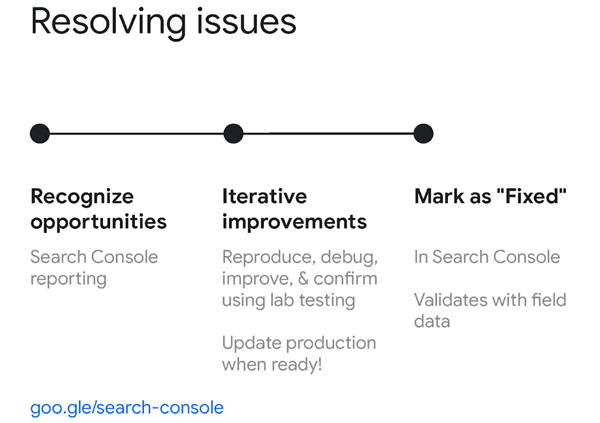
A good approach to improving these issues is to take a larger “issue type” and to work on resolving it. Upon identifying the issue, the first step is generally to reproduce the issue locally or within a testing environment.


Resolving Issues in Search Console


If addressing bigger issues is not possible, it is recommended to narrow down the issues using various tools and scripts available elsewhere. Once you’ve reproduced the issue, you can work to improve the vitals. Sometimes you may notice that other Google products or services are slowing down your pages. Google Search doesn’t give any special treatment to these, just like users generally won’t care why your pages offer a bad user experience. Treat embeds from Google, just like you would treat any other embedded resource.

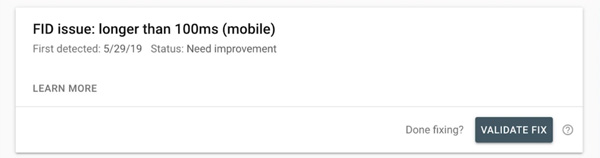
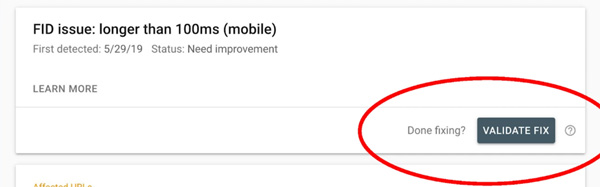
Once your live website is updated, you can notify Search Console that the issue is fixed. This is done using the appropriate drill-down report and clicking the Validate Fix button at the top. Search Console will then begin a review of the flagged URLs and report on how your improvements turned out over time.

Resolving Issues in Search Console


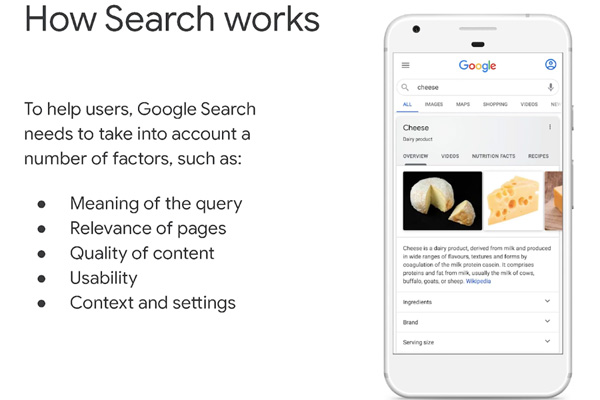
As mentioned earlier, there’s more to SEO than just page experience. Some of the factors are listed here. When determining search rankings, Google tries to weigh these factors appropriately. In general, Google prioritizes pages with the best information overall, even if some aspects of page experience are subpar.

How Search Works


A good page experience doesn’t override having great relevant content. For example, if someone is searching for your company’s name, it would be expected to show your company’s website, even if it’s slow or otherwise provides a subpar page experience. In cases where there are multiple pages that have similar content, page experience becomes much more important for visibility in Search. It’s not the only factor. And of course there’s much more to a website than just Search.

How Search Works

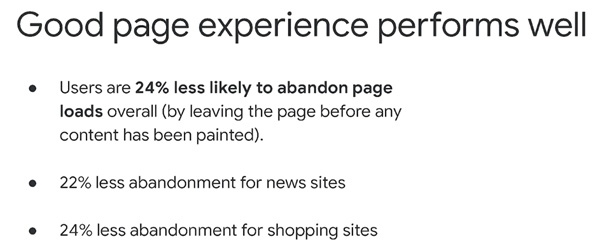
Google finds that when a site provides a good page experience, it generally performs well with users as well. For example, according to Google, users are 24% less likely to abandon page loads overall, 22% less abandonment for new sites and 24% less abandonment for shopping sites. There are a number of web page changes/fixes that can show this level of improvement for online businesses, and results like these are part of the reason Google prioritizes the web vitals metrics.

Core Web Vitals as a 2021 Ranking Factor

Google has announced that the Core Web Vitals will become a ranking factor this year. They have also committed to an additional notification six months before the specific date on which it will happen.

The switch to the Mobile First Index was recently postponed from September 2020 to March 2021. Therefore it’s likely that the Core Web Vitals will be made a ranking factor in the second half of 2021.

In any case, it is not advisable to postpone addressing Core Web Vital metrics on your site for too long. While Google is driving improvements that will also help you outside of pure SEO: faster, user-friendly websites, etc., improvements to the Core Web Vitals are technically complex and are likely to take time. In addition, more time will pass before the effects of these improvements are seen in the field data. Bottom line… SEO, with attention to Web Vitals, is definitely the way to go as far as improving your website’s page experience in 2021.

_________

For more information on ways to amplify and elevate your company’s search engine visibility, contact our Digital Marketing team.

We can walk you through the entire SEO process and pride ourselves on being responsive when answering any questions.

New, SEO

21 SEO Trends & Tips for 2021 (Part 3)

February 24, 2021

21 SEO Trends & Tips for 2021 (#15 to #21)


SEO 2021 Trend/Tip #15 – Semantic Search

Semantically related keywords will play a more important role in search in 2021. In the past the primary focus of SEO efforts was on the identification of the most important, relevant keywords. Today, it is common knowledge that secondary, alternative keywords are also crucial. Semantic search along with search intent will gain more prominence in the coming year. Google is not simply looking at keywords anymore. Query context is analyzed to ascertain a search intent. The more relevant the information that is provided via logically (semantically) related keywords — the better.

To optimize for semantic search, content needs to be designed so as to provide answers to questions that your target audience would ask. Optimize your content for topic clusters rather than simply focusing on keywords. Also, the use of structured data is recommended when logical. Most importantly, write content for people.


SEO 2021 Trend/Tip #16 – Local Search

Local search will be a more important part of an effective SEO strategy. People generally consider the internet to be a global world wide web. Although this is true, the actuality is that most people rely on search engines to research and find local products and services. They may be searching for a restaurant in a particular neighborhood or planning a night out on the town and researching what entertainment may be available. For a business to benefit from these kinds of queries, local SEO is extremely important — and constantly evolving.

A major, recent change in local search is the increase of zero-click searches, where a user’s query is answered within the Search Engine Results Page (SERP). Consequently, there is no need to click on the organic ranking search results. A contributing factor in the increase of zero-click searches is the use of featured snippets. A large number of zero-click searches tend to be local search queries with the results displayed on the SERP in a “Local Pack.”

So how does one get their business into the local pack? First and foremost, create and/or claim a Google My Business (GMB) listing. A strong backlink profile is also very important. A recommended approach is to research and identify the backlinks of your competitors to gain insights and, if relevant, target those links for your business website as well.


SEO 2021 Trend/Tip #17 – Google My Business Updates for 2021

Google My Business (GMB) has been rolling out new attributes throughout 2020 and continues to do so in 2021. Many attributes are associated with COVID-19, but there have also been new attributes focused on general business information so as to provide comprehensive Google My Business profiles.

Maintaining open and accurate communications for searchers is a primary goal for Google. The latest updates facilitate more informed searches on multiple levels. Google continues to add information to maps integrating Health and Safety attributes, a new COVID-19 Layer, and a new Google Guarantee badge for the service industry which is appearing up on Google Maps.

GMB Health & Safety Attributes

Food, Retail, and Service businesses can inform people as to the precautions the business is implementing; another tool in Google’s toolbox for business owners to share as much information to searchers as possible. The addition of any attribute that is relevant to your business demonstrates that the business is up-to-date with relevant information.

GMB Guarantee Badge

A Google Guarantee Badge means that if a client is not satisfied with a service booked via a Local Service Ad, Google may reimburse the client’s costs for the service:

  • If a customer is not satisfied with the quality of your work, Google may, in its absolute and sole discretion, reimburse the customer up to the amount on the job invoice for the initial services provided by you, up to a lifetime limit.
  • Services must be booked through Local Services Ads. We won’t reimburse for add-on or future projects, damages to property, dissatisfaction with price or provider responsiveness, or cancellations.

There are qualifications to the Guarantee Badge as well as a certification fee:

  • The service must be booked through Local Service Ads
  • Must be a Local Service Ads Upgraded Profile
  • Must be a home service that passes a background and licensing check

The upgraded profile costs an additional $50 dollars per month for the green checkmark alongside your business.

COVID-19 poses many new business challenges. It is extremely important to keep focused on Local SEO fundamentals while also monitoring updates on Google Maps and Google My Business. Maintaining your company’s information so that it’s up to date by including all relevant categories, along with consistent Google My Business posts are imperative.


SEO 2021 Trend/Tip #18 – Data Analysis and Analytics

Data Analysis and analytics must be a priority in order to achieve high search rankings rankings. Data Analysis and analytics helps you to understand buyers’ behavior, design digital marketing campaigns, and compose targeted messages. Analytics is an indispensable aid for identification and verification of which URLs are being crawled by search spiders, referral sources, page load times, website indexing, bounce rates, response errors, web page redirects and much more.

Analytics is also very helpful in the identification of web pages that you may not want to be indexed as well as identification of questionable traffic sources, such as spam sites, which can damage your site’s EAT credibility. Paying attention to these details allows you to identify and address areas that are successful and profitable, as well as where your efforts may be coming up short, or failing.


SEO 2021 Trend/Tip #19 – Reputation Management

Reputation management continues to become more important each passing year. That’s because online research before making a purchase – whether online or in-store – continues to increase as well. With that, you need to focus on your reputation management in 2021 if you hope to continue growing or even just sustaining your business. So how does one approach reputation management in 2021?

A positive image for your business translates into more conversions, more sales and more referrals. Ideally, the goal is to have an impeccable online reputation.

The internet allows web users to voice their opinions online. This is great as far as free speech is concerned, but it also opens the door to anyone that may want to generate negativity. Successful reputation management builds and maintains a positive reputation in search engine results and on the various social media platforms while minimizing and/or eliminating negative reviews.

Online communications and reviews can occur at any time of the day or night. Building, as well as maintaining a positive reputation requires continuous vigilance. Negative reviews can potentially be a formidable threat to your online reputation. On the other hand, they can also be one of the most effective ways to promote and maintain a positive image. Online reviews are a great way to show potential customers the benefits of your product or service by communicating via past customers; an effective marketing strategy and way to protect your online reputation.

One of the most effective approaches to removing or preventing negative reviews is to for your business to have an online presence in all the right places. Your business should be registered on a variety of different business directories, registries, social media platforms, and review websites to maximize your business’ visibility. To maximize positive coverage, be sure to post news and information regularly.


SEO 2021 Trend/Tip #20 – Ranking Factors for Top 3 Search Engines

Google uses over 200 ranking factors in their algorithm. Some ranking factors are proven. Some are controversial. Some are only speculation. Here is a compiled list of the most important, generally agreed upon as valid, search ranking factors for 2021.

Search Engine Google Yahoo Bing
Quality of Inbound links Very important Somewhat important Somewhat important
# of Unique Linking Domains Very important Somewhat important Somewhat important
Content Freshness Can be Very important Somewhat important Somewhat important
Quantity of Inbound links Somewhat important Very important Very important
Keyword in inbound anchor text Very important Very important Very important
Directory listings Helpful Helpful Helpful
Keyword in title tag Very important Very important Very important
Keyword in H1 header Important Important Important
Keyword in body text Important Important Important
Keyword in domain name Very important if exactly matches query, otherwise somewhat important Somewhat important Somewhat important
Keyword in URL Somewhat important Somewhat important Somewhat important
Keyword in meta description Not important to rankings, but helps click-throughs Not important to rankings, but helps click-throughs Not important to rankings, but helps click-throughs
Keyword in meta keywords Not important Not important Not important
Page freshness Very important Not important Ranks new pages poorly
Toolbar PageRank Still a Good Indicator N/A N/A
Preference for Big Brands Yes No No
Bounce Rate, Time on Page, Time on Site Important Important Important
HTML validation Not important Not important Not important


SEO 2021 Trend/Tip #21 – What Will Each Search Engine Penalize You For?

The only real penalty, according to Google, is known as a manual action. This means that a human reviewer has reviewed your website and issued a penalty for violating some aspect of Google’s Webmaster Quality Guidelines. Google penalties vary from website to website depending on the severity of the violation. If you receive a penalty notification, you’ll need to take action and submit a reconsideration request to get back in favor with the search engine. Here is a list of currently recognized actions that can land you a penalty.

Search Engine Google Yahoo Bing
Paid links Yes Possible Possible
Mininets Yes Yes Yes
Link farms Yes Yes Yes
Hidden Text Yes Yes Yes
Keyword stuffing Yes Yes Yes
Duplicate content Yes Panda Yes Yes


Return to: 21 SEO Trends & Tips for 2021 (#1 to #7)


_________

For more information on ways to amplify and elevate your company’s search engine visibility, contact our Digital Marketing team.

We can walk you through the entire SEO process and pride ourselves on being responsive when answering any questions.

New, SEO

21 SEO Trends & Tips for 2021 (Part 2)

February 22, 2021

21 SEO Trends & Tips for 2021 (#8 to #14)


SEO 2021 Trend/Tip #8 – Artificial Intelligence, Search and SEO

Google RankBrainOne of the most important SEO trends in 2021 is adapting website optimization efforts in response to how Artificial intelligence (AI) is redefining the future of how humans interact with online content. Google’s AI algorithm, called RankBrain, plays a major role in determining Google’s search ranking factors for search engine results page (SERP) results.

RankBrain, has the unique capability to learn and interpret signals based on discoveries and insights and is designed to only improve with time, making Artificial intelligence a major SEO trend to follow.

So, the question is how to you optimize SEO for RankBrain AI? While Google will not share details, information technology experts believe that user experience (UX) signals are the primary determining factor. These could include variables such as click-through rate and/or time spent on a web page. One needs to engage readers with relevant, useful, well-organized content. On-page SEO tools are available to check and assess things like page strength, readability, backlinks, and more.


SEO 2021 Trend/Tip #9 – Voice Search  & Search Queries

With technological innovations such as Google Assistant, Amazon’s Alexa and Apple’s Siri, voice search is quickly becoming the defacto way that people search for information. As the technology improved, it’s become extremely popular. Experts claim that the percentage of households that will own a smart speaker device by 2022 will reach 55% or more.

Voice SearchWhen implementing SEO for voice search, the keyword queries that need to be considered tend to be longer phrases that are used in day-to-day conversation. Voice searches tend to return more relevant results with more natural, longer phrases. When people type a query in a search engine, the tendency is to abbreviate. For instance, a person may voice search, “What are the top SEO trends for 2021?” but when typing, input the phrase, “top SEO trends 2021.”


SEO 2021 Trend/Tip #10 – Mobile-Friendliness

In 2019, Google introduced mobile-first indexing, where it prioritizes a website’s mobile version rather than the desktop version. Makes total sense, considering that it is predicted that nearly 75% of internet users, if not more, will use the internet via a mobile device by 2025.

SEO in 2021 should include testing the effectiveness the mobile version of your website. To aid users, Google has a mobile-friendly test that it offers users for free. Regular review of your website’s “mobile usability” report via the Google Search Console is also strongly recommended. To ensure that your web page is user-friendly, Google must be able to crawl the URLs. Make sure there isn’t an inappropriate “disallow directive” active and be sure to use the same meta and robots tags on the mobile site and desktop site. Also, be aware that the Googlebot spider will not load mobile content that requires user interactions such as clicking and/or swiping.


SEO 2021 Trend/Tip #11 – Google E-A-T Principle

Content that satisfies Google’s E-A-T principle will achieve higher rankings in 2021. Google has stressed that quality content is crucial for successful ranking. But exactly what does Google mean by “quality?” E-A-T stands for: expertise, authoritativeness and trustworthiness. The E-A-T elements assist in the determination of whether a web page has relevant quality content. The E-A-T principle is particularly applicable in business niches that are categorized as “your money, your life” (YMYL) categories, such as health care, medical advice and finance.

There are numerous ways that one can achieve quality, EAT compliant content. Creating buyer personas, helps to understand the type of content that clients find valuable. Conducting search intent research will help with the mapping out consumer journeys. Using the aforementioned information will help create content that your ideal users prefer.

It is very important to be mindful of the E-A-T principle when composing content. Legitimize claims with facts and statistics. Link to respected, authoritative websites – “.edu” and “.gov” sites. .If possible, to help your site meet E-A-T criteria, invite authoritative sites to link back to yours.


SEO 2021 Trend/Tip #12 – Predictive Search

In 2021, Predictive Search will improve. Google Discover was rolled out in 2017, introducing a new sort of search — one that does not necessitate a user search query. Google Discover is another Google AI tool. This tool identifies a user’s behavior patterns over the course of time and learns the respective user’s habits. Utilizing this information, Google Discover is able to identify the most relevant content that will be of interest to the user.

Google Discover already lays claim to nearly a billion active users. If Google indexes your web page, it will be included in Google Discover. Online content is ranked according to AI algorithm inspection of content quality, and user engagement. Even though Google has shared any precise factors, it appears that location, browsing and search history, as well as app usage and calendars are all considered relevant.


SEO 2021 Trend/Tip #13 – Video & Video Optimization

SEO will require the inclusion of Video and Video Optimization as part of one’s overall SEO strategy. Online video is hot!. YouTube has over a billion users. If you are not yet creating video content, this is the time to start. In 2021, video consumption is forecasted to exceed all other types of online content.

So how do you optimize video content? Be sure to optimize the name and description of your video channel. The video channel description should not just be stuffed with keywords but should provide a user-friendly overview your channel’s content.

Proper utilization of keywords is crucial. When optimizing video for YouTube, you can use the it’s auto-complete search feature. Just type in your video’s topic and take note of the results that are offered in the search input box, basically related keyword suggestions, indicating exactly what people are querying on YouTube..


SEO 2021 Trend/Tip #14 – Image Optimization

Image optimization will be more important in search. Image search has evolved dramatically in recent years. in the past people were only able to view images. Going forward, images will be used to buy products, get information, and much more. Google has been recommending proper tagging and optimization of images for many years, apparently part of Google’s future vision.

If images on your website are not optimized, it is strongly recommended to do so as soon as possible. You should use relevant, high-quality images and be sure to optimize the respective file name so that it’s relevant to content on the respective web page. Be sure to utilize alt image tags, which spiders rely on to classify images. And be sure to include images to your website’s site map, to facilitate search spiders crawling and indexing.


NEXT: 21 SEO Trends & Tips for 2021 (#15 to #21)


For more information on ways to amplify and elevate your company’s search engine visibility, contact our Digital Marketing team.

We can walk you through the entire SEO process and pride ourselves on being responsive when answering any questions.

 

New, SEO

21 SEO Trends & Tips for 2021

February 18, 2021

Search engine optimization (SEO) is an effective way to attract consumers to your online business platforms — provided that you do it right. Being that SEO is constantly evolving, staying on top of the latest search algorithm updates can be challenging. Acknowledging the fact that SEO is constantly changing, here is a compilation of 21 SEO trends and tips for 2021.

Google makes over 3000 algorithm changes every year. SEO changes so often because of the extraordinary number of algorithm changes released by Google each year. Admittedly, most of these changes are small, but the major algorithm updates can have an enormous effect on your Google search rankings. Most recently, in December, Google began releasing a new core algorithm update which, as predicted, produced new winners and losers in the search rankings. As far as an actionable strategy — Google states that if your rankings have dropped because of their most recent core update, there are no specific actions that one should take to recover, and that a negative rankings impact may not be a signal that anything is wrong with your web pages. More information about Google Search Core Updates an be found on their developer blog – What webmasters should know about Google’s core updates .

Then how does one prepare for the major algorithm updates in 2021?

What other aspects of SEO are changing in 2021?

Personally, I’ve been practicing SEO for over two decades. During the early days of SEO, late 1990s to early 2000s, ranking on page one was literally as easy as adding keywords to a title tag or within the body text of a web page’s content. Eventually it was necessary to do things like on-page SEO and link building, but it wasn’t complicated.

Today, the reality is that there is no SEO silver bullet. Despite some opinions that SEO is not effective or even dead, the truth is that SEO still works, albeit, a much more complex process.


21 SEO Trends & Tips for 2021 (#1 to #7)


SEO 2021 Trend/Tip #1 – Search Rankings Will Fluctuate

Search Engine Rankings will fluctuateThe first important SEO trend is that your search rankings will fluctuate. Despite the fact that Google releases many ranking algorithm changes every year, the most important, and of greatest consequence, are the major updates; your search rankings may go up or they may go down, or, less frequently, they may remain unchanged.

Doing all the right SEO stuff doesn’t guarantee that rankings will always go up. Rankings may very well still go down. But, by continually doing the right SEO stuff and putting the user’s experience first, in a year, your search rankings will have improved. Your website traffic should also be up, but you need to get accustomed to and accept fluctuating rankings.


SEO 2021 Trend/Tip #2 – Search Engine Ranking Position (SERP) #1 

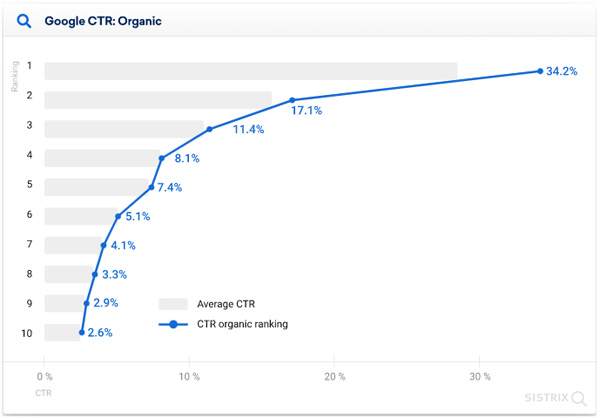
Search engine ranking position (SERP) #1 has never been more important! The #1 ranking spot is the goal. Ranking #1 has never been easy and will continue to be extremely challenging in 2021. It’s not just about on-site SEO and more links than your competitor any more. User metrics are more significant than ever. With Google constantly making new algorithm changes, the number of variables that can affect your traffic and revenue are daunting.

Google CTR vs Organic Search Result Position

The lower you rank on page one, the fewer clicks you will receive. Being ranked in the top 10 spots, on page one is no longer enough. There are a significant number of queries where there aren’t 10 spots on page one. Page one search result listings on Google may only contain seven, eight or nine query results. The top spot is crucial spot because Google is including many other types of search results that result in decreased organic traffic.

This should not be interpreted as the demise or irrelevance of SEO. There are an ever-increasing number of people using and searching via Google, so position two or three or even on page one may still reap benefits. But search ranking position #1 has a massive advantage over position two, three or four, even on page one of the SERP.


SEO 2021 Trend/Tip #3 – It’s All About User Experience (UX)

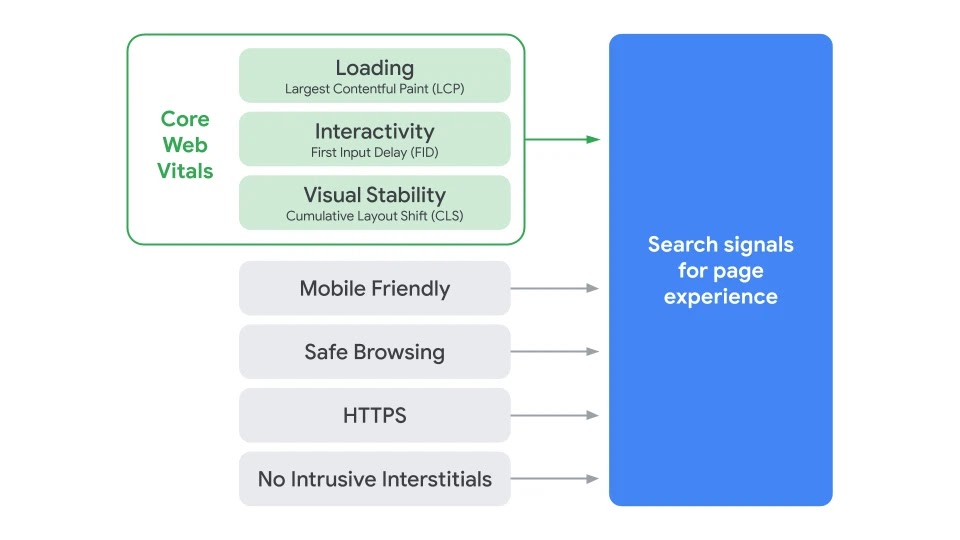
SEO in 2021 is all about user experience. Google is combining the signals derived from Core Web Vitals with their existing Search signals for page experience, including mobile-friendlinesssafe-browsingHTTPS-security, and intrusive interstitial guidelines, to provide a holistic picture of page experience. Because Google continues to work on identifying and measuring aspects of page experience, they plan to incorporate more page experience signals on a yearly basis to both further align with evolving user expectations and increase the aspects of user experience that can be measured.

Google Search UX Core Web Vitals


SEO 2021 Trend/Tip #4 – Niches And Niche-Focused Websites

The greatest SEO opportunities will be in niches and building building niche-focused websites. People who focus on a particular niche tend to demonstrate greater level of expertise tend to be more of an “authority” for that niche; not as a rule, but quite often the case. Over time, they end up with better rankings simply because they cover their niche in greater depth on their respective topics.

In the online business world, people are usually searching for very specialized solutions. When Googling for the best dog food for your Old English Bulldog, are you searching “best pet food?” Most likely you’re searching for “best dog food” for your “English Bulldog” of a “specific age.” You can obviously get very narrow. The more specialized you get, the easier it is to to stand out and reach your desired audience.


SEO 2021 Trend/Tip #5 – Length of Content

In the past, recommended content length varied greatly, from 200 to 3,000 or more words per page, depending on a topic’s complexity and objectives. But in general, the primary goal of website content has been, and will continue to be, to get one’s message across effectively and concisely, motivating the reader to take action.

In 2021, the length of content will not be as significant as in the past. Lengthy content can still be helpful for some queries and rank high, especially  technical subject matter, but you need to ask yourself, “Does someone really want to read a 2,000-3,000 word article when the same information is available via an educational animated gif or an instructional video?” Again, in some cases, a longer discussion may be beneficial if written well, and may result in high engagement, backlinks, shares, etc. In any case, strive to be clear and as detail-oriented as necessary, but make your point without digressing too far from the primary theme of your content.

When Google began releasing updates focusing on user experience in their algorithms, variables such as content length became less important. Google knows if a user bounces off your page, regardless of content length, the page is perceived as less relevant and the page’s rankings will go down.

Don’t be overly concerned about things like word count or keyword densities. Instead, focus on the quality of your content and giving the user the information that they’re looking for in as clear and concise manner as possible.


SEO 2021 Trend/Tip #6 – Organically Generated Backlinks

The number of backlinks will not be as important as the quality of the links. User metrics can easy identify if you acquire too many backlinks too fast. This will be construed by Google as attempting to “game” search engine rankings and will actually cause longer waiting times to rank and/or can damage your search rankings.

The recommended approach for 2021 is to publish your content, not concern yourself with building links and allow links to it occur organically. Then, after your content has been live for several months, manually reach out to relevant link prospects. When done this way, industry experts are seeing that rankings climb faster and higher than if building tons of links from the start. Building tons of links is just not authentically organic. This absolutely applies to buying links. Never buy links in an attempt to get away with breaking Google’s policies. The best practice in 2021 is to build links slowly and patiently.


SEO 2021 Trend/Tip #7 – Featured Snippets

Featured snippets, or Position Zero results, appear at the top of the SERP in a rectangular box. They are useful for searchers as well as beneficial for websites. However, the content that is shown in a Featured Snippet for a given search is determined by Google’s AI search algorithm and not easily manipulated or optimized for, within a website. The exact method for getting one’s web page in the Featured Snippet isn’t fully understood. Digital marketing and SEO experts utilize a few strategies that may be helpful such as answering a specific question via bullet points within well-structured content.


NEXT: 21 SEO Trends & Tips for 2021 (#8 to #14)


For more information on ways to amplify and elevate your company’s search engine visibility, contact our Digital Marketing team.

We can walk you through the entire SEO process and pride ourselves on being responsive when answering any questions.

Digital Marketing Updates

Branded Content, Branded Ads and Driving Efficient Purchase Intent

June 3, 2020

Digital marketing agencies need to be at the top of their game when it comes to understanding and leveraging new products. In times when new ad production is more challenging, sponsoring branded content from creators and publishers can be an attractive option. But when it’s also critical to make the most of every media dollar, how can marketers also make sure they use branded content as efficiently as possible to improve a brand’s bottom line?

Part of the answer lies in relying on a multiplicity of voices.

Marketers already know that when consumers hear about a brand or product from multiple sources, they’re more likely to want to make purchases, sign up for subscriptions or otherwise take meaningful actions.

Marketers can also use a “surround sound” of voices—in the form of standard ads and sponsored branded content from creators and publishers—to drive efficient purchase intent. That’s according to a new Facebook Marketing Science meta-analysis of 26 lift studies with CPG advertisers across product subcategories, global regions and ad formats like static images or video.

How a “surround sound” approach aids purchase intent

Our analysis saw that the combination of branded content ads and standard brand ads from the same campaign across Facebook and Instagram drove purchase intent at a four-fifths lower average cost per person than when using either branded content or brand ads alone.

Mean cost per incremental person (CPIP): Purchase intent

(lower cost is better)

Controlled multi-cell lift studies with CPG clients across regions & sub-verticals; n=15 studies, subset of action intent asking specifically about purchase

Cost per incremental person, or CPIP, represents the ad dollars spent on each individual that responded favorably to a question about an ad. In this meta-analysis, the mean CPIP for purchase intent was 82% lower for the mixed approach—far more efficient than campaigns that consisted of only branded content or only ads.

This illustrates how multiple “voices” can accelerate the customer journey for CPG products and how branded content can work in tandem with ads as part of a broader digital strategy.

The persuasive power of branded content

This analysis within the CPG vertical shows how content from creators and publishers—combined with the trust consumers have in a brand—can lead to a specific action. It also reinforces insights we have shared in the retail fashion category.

For example, a study of US fashion shoppers found that creators can wield significant clout; almost a third of those shoppers follow an influencer for their product reviews, and about two-fifths said they follow an influencer to keep up with trends.1

Reasons why fashion shoppers in the US follow fashion influencers

“Global Retail Fashion Consumer Study” by Accenture (Facebook-commissioned survey of 12,278 people in the US, Canada, Brazil, France, Germany, UK, Australia, India, Indonesia), Nov 2018 to Feb 2019.

The “surround sound” approach can be powerful if purchase intent is the campaign objective—but as always, marketers should keep their specific marketing goals in mind.

For ad recall, use branded content or ads separately

While branded content and ads together were the most efficient in driving purchase intent, this integrated approach wasn’t the clear winner throughout the marketing funnel. In the new meta-analysis, campaigns with only branded content or only ads had a lower mean CPIP for ad recall compared with mixed campaigns (22% lower for unaided and 14% lower for aided).

We think this is because branded content-only campaigns and ad-only campaigns tended to have a higher frequency per individual ad. This made it more likely for people to learn through repetition of the same creative, thus driving ad recall.

Mean cost per incremental person (CPIP): Ad recall

(lower cost is better)

Taken together, these different CPIP results reinforce the need to keep your campaign goals in mind. Nuances—like whether you combine sponsored branded content and ads together as part of the same campaign—should reflect the actual outcomes your brand is looking for.However, if you’re looking to optimize lower-funnel metrics efficiently, the results are clear: Branded content and brand ads together make a huge difference for purchase intent.

What it means for marketers

Embrace a “surround sound” approach to efficiently boost purchase intent.


Using these two strategies in concert—not separately—is a cost-effective way to drive people to want to make a purchase. And as it turns out, purchase intent is the easiest way to make an impact. The biggest results uncovered in this research revolved around purchase intent, where, on average, mixed campaigns drove lift at 82% lower cost. Compare that to ad recall, where ad-only and branded content-only campaigns drove lift at only a 22% lower cost.

Keep your true advertising goal in mind.

Purchase intent is a valuable lower-funnel marketing metric, but it won’t be the campaign goal every single time. Stay true to your brand’s needs: If the goals are best served by upper-funnel outcomes like ad recall, look to the strategies that will actually drive these efficiently at scale. Additionally, consider how a measurement-first approach can help you build a strong brand.

Look to the auction for purchase intent.

If you’re interested in cost-effective purchase intent, here’s some good news. In a sample of the mixed campaigns from the meta-analysis, the Facebook auction often dynamically served both ads and branded content ads to audiences, with an average of 73% of people seeing both. This means there’s no need to set a manual budget split; you can let the auction deliver the right creative at the right time.


The Social Group™ is a Facebook Partner Agency and Blueprint certified. Contact our social media marketing team to help elevate and quantify your social media efforts. If you’re looking to expand into other digital marketing initiatives, reach out to our Search Engine Optimization and Google Ads team.

Source unless otherwise specified: Facebook data, 21 controlled multi-cell lift studies with CPG clients US, RU, PH, GB, ES, DE, CA, PE, BR, Mar 2018-Sep 2019
SEO

Top SEO KPIs To Look At

May 5, 2020

SEO Agency KPI Metrics – Key Performance Indicators

You may have a captivating, aesthetically wonderful website. But without utilizing SEO and targeting your target audience, where’s the return? It’s like having a Ferrari with a lawnmower engine. It looks great, but you won’t be getting anywhere quickly. 

Top SEO agencies can be difficult to find. It seems everywhere you look there is an SEO agency that promises this or that. But can they prove success? Are they transparent? Are they overpromising and under delivering? The Social Group™ team is a Google certified digital marketing agency with a hands-on and collaborative approach. 

Whether you’re a pharmaceutical agency targeting consumers coast to coast or a local live event, the top SEO key-performance indicators apply whether you need local or national search engine optimization. Below are the top SEO KPI metrics we as an agency and you as a business should be looking at.

Bounce Rate

Take a look at your bounce rate right now. Is it higher than 60%? Higher than 70%? That’s not great, but you can definitely improve it. A bounce rate indicates when a website visitor comes to your site and exits without taking any action whatsoever. Essentially, a bounce rate reflects the percentage of visitors who bounce off of your website.

Google Analytics considers website interactions by visitors if they clicked on at least one additional page such as “About Us” or your contact page. An average bounce rate is arguably around 50%. A rule of thumb is you don’t want to be over that mark. This means that half of your total website visitors leave without taking any action or clicking any other pages of your site. Keep in mind, however, that this can vary greatly depending upon your industry. Remember, Google needs to provide people with a dependable service. A dependable and consistent service to users means more users, which means more advertising revenue for Google. Because of this, Google needs to return relevant and qualified search results. If a website visitor finds your website, then “bounces” back to the search results page (also known as “SERP”) it indicates to Google that the site is not relevant, is not user friendly or may appear too “spammy” with cluttered ads.

Conversely, if you have a low bounce rate, say around 25%, it’s indicative of your website being well designed, easy to navigate and filled with relevant content. Always try to hit the “E-A-T” threshold. Google defines the EAT strategy as providing Expertise, Authoritativeness and Trustworthiness.

Organic Sessions

Organic sessions refer to website visits that resulted from search engines like Google and Bing. In other words, visits that came to your site organically, and not from paid ads. Organic sessions can be thought of as “free” sessions in that you’re not running Google Ads to drive traffic. Of course, you would need, and benefit from, a consistent and well planned search engine optimization strategy.

Google defines a website session as “the period of time a user is active on your site or app. By default, if a user is inactive for 30 minutes or more, any future activity is attributed to a new session. Users that leave your site and return within 30 minutes are continued as part of the original session”. These metrics can be easily viewed in your Google Analytics dashboard.

Organic traffic growth is absolutely critical. It’s the lifeline of your website because it aligns directly with your SEO strategy and Google’s modus operandi: providing users with relevant and valuable content. In addition to having a strong SEO strategy, social media also contributes greatly to organic traffic by raising brand awareness and generating valuable click thrus. Increased organic traffic allows you to occupy increased digital real estate on Google.

Some basic tips for on-site SEO include relevant page titles and meta description along with clearly defined call-to-actions (CTAs). Reach out to our SEO team if you have questions about starting.

Pages Per Session

Relatively self-explanatory, pages/session is a basic metric that indicates, on average, how many pages a user visits during a single session. Keep in mind that pages/session also counts repeated views of a single page. This is an important SEO metric because it clearly indicates the overall value of your website as well as user-friendliness. 

If you have a single page website, then one page per session is great. In that case, you’ll want to take a look at how much time is spent on the site by a user. Increased pages per session show that users are frequently finding valuable content across your website and will likely correlate to increased session duration.

Average Session Duration

This is one of our favorite SEO metrics that can be easily measured in Google Analytics. This KPI will tell you how much time a user is spending on your website within a single visit. If you have an eCommerce site, then you’ll want people to easily navigate through and search different products. If you have a website about a live event, then you’ll want people to easily find things such as performance lineups, different ticketing options and so on. Solid average session durations can increase revenue since it is a common KPI that corporate partners will ask to look at when considering to advertise on your website.

Remember to focus on clear CTAs to convert leads into conversions.

Keyword Ranking Increases

This is commonly the first thing people look at when determining the success of their SEO strategy. The closer you are to ranking on the first page of a SERP, or the higher up you are, the better. Keyword rankings indicate where your site is ranking for any given search query. For example, if you are a winery specializing in California reds, you may want to focus on those keywords. And if you’re ranking for them, that’s great! But there is always, always, always competition so once you’ve achieved a high ranking, don’t falter on your SEO strategy. Once you obtain, it’s important to maintain!

That, of course, is easier said than done. Google algorithm updates can throw a monkey wrench into your rankings. It’s important to stay on top of the latest ranking methods, and to stay in contact with your SEO agency. Drops in rankings commonly occur, so don’t panic. Keep an eye on the above metrics we mentioned in your Google Analytics. If they’re dropping, then you should look at what has changed on your site. The most important thing is to target relevant keywords. Over-optimization and keyword stuffing can be a red flag to search engines. 

Leads/Conversions

Step one: rank for relevant keywords related to your industry and products so you can develop leads on your website. Step two: turn those leads into conversions. Whether you are selling products, registering people for an event, or running a data capture campaign, it’s important to convert those who are visiting your site. Examples of a conversion can be a phone call, completed purchase, newsletter signup, contact submission and webinar registration.

Conversions can be easily tracked by your SEO agency by setting up goals and events in Google Analytics. This will allow you to determine various dimensions such as percentage of gender differences, conversion rate differences on mobile versus desktop usage, and commonly visited pages. The most important way to increase conversions is to have an easy-to-navigate website and one that is mobile-friendly. You can test to see how mobile-friendly your site is by using Google’s Mobile-Friendly tool. You’ll also want to look at how clear your CTAs are, how relevant and persuasive your content is, and the ease and consistency of your conversion funnel.

Page Load Time

How annoying is it when you try to navigate to a site and it just loads, and loads, and loads? How patient are you when this happens? Don’t let this be an issue for your website. In today’s world of instant gratification, expedited load time is essential and should not be overlooked. This metric also contributes to the various KPIs we’ve already discussed. 

Site visitors will typically abandon a website if it takes longer than three seconds to load. So make sure to test yours. Today. Also, whenever you add content or update content on your site, be sure the design is thought out and that images or video are scaled appropriately. Think of it as designing a house. It’s much easier to design the floorplan with a well thought out strategy from the beginning rather than trying to knock down walls and move things around once it’s already built.

Exit Pages

An exit page is the final page visited by a site user before leaving. It’s not necessarily a bad thing. People are going to leave your site (hopefully after they’ve converted). An exit page can be a purchase confirmation or thank you page. But be sure to monitor what those exit pages are. If you’re selling mattresses online, and a common exit page is a product page, rather than a purchase confirmation page, then you’ll want to dig deeper and find out why. An exit rate is also an important KPI to consider as it is the percentage calculated by dividing the number of exits by the number of pageviews for any given page on your website.

Crawl Errors

Last, but not least, crawl errors just sound negative. “Crawl error”. Sounds like something is crawling that shouldn’t be. Anyway. Google and other search engines need to crawl and index your website in order to see and assess its content. If you have crawl errors, it means search engines are having trouble looking at your site and thus determining how it should be ranked. 

Our SEO team can identify any crawl errors your site may have and address them promptly. Although you wouldn’t want things crawling around your house (unless of course it’s your baby), you do want Google and other search engines to crawl and index your site. So make sure they’re free to do so.


Contact Us

These are just some of the important SEO metrics we look at. Trust us, there’s a lot more. But this list should give you a good idea of what to look for. Our team has experience with both national and local SEO campaigns across a variety of industries from hospitality and tourism to nightlife and eCommerce. We’re proud to be a Google certified agency and would be equally proud to partner with you.

If you’d like to work with us, drop us a message!

Social Media Marketing

Facebook and Instagram Verification Process

April 26, 2020

Have you ever wondered what you can do to obtain the coveted blue check verification? How do you apply? What happens when you do? What factors are considered? Here you’ll get the scoop on the verification process and ways to secure your accounts on Facebook and Instagram.

Verification Badges

Verified badges on Facebook and Instagram appear next to the Page or account’s name, as well as in search. This shows that Facebook and Instagram have confirmed that an account is the authentic presence of the creator, public figure, celebrity, or global brand it represents and helps people more easily find the accounts they wish to follow. Facebook and Instagram’s verification team vets all requests thoroughly and base their review on a number of inputs to determine whether an account is eligible to be verified.

Verification Review Criteria

Facebook pages must follow Facebook’s Terms of Service and Community Standards
Instagram accounts must follow Instagram’s Terms of Service and Community Guidelines.
In addition to the above, accounts must also be:
Authentic: Your account must represent a real person, registered business or entity.
Complete: Your account must be public and have a bio, profile picture and at least one post. Your profile can’t contain “add me” links to other social media services.
Unique: Your account must be the unique presence of the entity it represents. Generally, one account per entity may be verified, with exceptions for language-specific accounts. Facebook and Instagram doesn’t verify general interest accounts (e.g., puppy memes).
Notable: Your account must represent a well-known, highly searched for individual, brand or entity. We review accounts that are featured in multiple news sources. Facebook and Instagram don’t consider paid or promotional content as sources for review.

Verification on Facebook

Contact our social media marketing team if you’d like help applying for a blue verification badge.
To request a blue verification badge, your Page or profile must comply with Facebook’s Terms of Service and have several supporting documents.

Facebook - Request A Blue Verification Badge

Safety on Facebook

Stay safe and secure by learning the ways to protect yourself, your fans and your account on Facebook.
Turn on 2-factor authentication and add an extra layer of security for your account.
Get alerts like notifications on unrecognized logins.
Manage your time so you can have more control over time spent on our platforms and a new way to limit notifications.

Facebook - Steps to Request A Blue Verification Badge

Safety on Instagram

Learn the ways to protect yourself, your fans and your account on Instagram

Add an extra layer of security for your account by turning on 2-Factor Authentication
Filter out comments you don’t want to appear on your posts with comment moderation.

Take control over time spent on our platforms and limit notifications.

The Social Group™ is a Facebook Partner Agency and Blueprint certified. Contact our social media marketing team to help elevate and quantify your social media efforts. If you’re looking to expand into other digital marketing initiatives, reach out to our Search Engine Optimization and Google Ads team.


Source: Facebook Partner Agency Resources

Social Media Advertising, Social Media Marketing

The Social Media Measurement Journey

April 22, 2020

Focus on Metrics that Matter

Begin with making a strategic decision on what is measurable that best aligns to your brand’s broader business goal. Consider what data is available and what tracking capabilities are possible through Facebook platforms or partners such as Instagram and Audience Network.

Focus on metrics tied to a key business goal (e.g. brand awareness or online sales) and try to move away from a reliance on proxy metrics (e.g. post engagement or click through rate). These can still be tracked as secondary metrics..

Better data signals lead to more actionable measurement. Digital marketing through Facebook’s product platforms offer a variety of methods to use data signals for measuring outcomes. Some examples include use of the Facebook pixel, App SDK or Offline Conversions. There also are solutions to help you customize this data further (e.g. Custom Conversions) to get closer to the metric that really matters. To set up for advertiser success, focus on metrics that matter and consult with our social media marketing team.

Questions to Consider

  • What success metrics are being tracked?
  • Are these metrics driving your brand forward, or are they proxies?
  • If proxies, are they correlated with business outcomes?
  • What data sources are fueling my success metrics?

Signals

  • Ads Manager Reporting Metrics (Reach, Impressions, Clicks)
  • Facebook Pixel
  • Facebook or Partner SDK
  • Offline Conversions
  • Custom Conversions
  • Leads API


Understand Results that Facebook Currently Drives

Understand the return on investment Facebook is driving for your brand. Assess incremental impact of the key metric, if possible.

The solutions we recommend use experimental design to evaluate causal impact of advertising. We define incrementality as the degree to which a measurement method estimates the true causal effect of an isolated marketing activity. The ideal process is to design an experiment using a simple test vs. control framework to isolate the variable. In this case, the variable tested will help a brand better understand the value of media spend.

The Social Group™ team, working with Facebook, offers a variety of options to explore incrementality: using the self-service lift solution (Ads Experiments available in Ads Manager).

To set you up for success, understanding the incremental return on ad spend is critical before moving into testing specific variables for further optimizing on the platform.

Questions to Consider

  • Is Facebook and related products driving sales?
  • Is Facebook and related products driving my brand?
  • Do I know if these results are incremental?
  • Which attribution model should I use

Measurement Solutions

  • Facebook managed and partner* Brand Lift (baseline incremental performance testing)
  • Facebook managed and partner* Conversion Lift (baseline incremental performance testing)
  • Ads Experiments (self-serve Brand Lift and Conversion Lift)

*requires a Facebook rep to activate and inform which regions are supported for these solutions. The Social Group™ can help.


Optimize Your Performance

To make the most of a brand’s efforts across social media marketing, it is best to develop a testing mindset, adjusting our strategies based on insights from our tests to decide what works best. Our best practices can guide you in getting started and set up for success. Beyond that, we recommend creating a brand specific test plan to learn what works to further optimize towards your business goals.

We begin with a hypothesis and align on decisions we will make based on the test outcome before getting started. Solutions offered include Split Testing (A vs. B) and multi-cell Lift (A with test and control vs. B with test and control). These designs allow us to isolate one variable: bid strategy, creative, placement, etc. to better understand which strategy drives more of the key business outcome your brand prioritizes.

Questions to Consider

  • Which creative strategy works better?
  • Which audiences respond best to my message?
  • How should I address full funnel messaging?
  • What is the impact of prospecting on sales outcomes?
  • Which campaign drives more awareness of a product?

Measurement Solutions

  • Split Testing (A vs. B; no control groups)
  • Facebook managed Conversion Lift (comparison testing; with control)
  • Facebook managed Brand Lift (comparison testing; with control)
  • Facebook managed and partner* offline sales lift measurement solutions (comparison testing; with control)

*requires a Facebook rep to activate and inform which regions are supported for these solutions. The Social Group™ can help.


Determine How Social Media Marketing Fits in the Media Mix

Solutions in this phase help brands better understand how channels assist one another and work together to drive outcomes when more than one is involved in a consumer journey. These tools inform longer-term strategic decisions like media budget allocation.

In order to best understand how much an advertiser should credit Facebook and family products such as Instagram as a channel, it is important to have first addressed how many incremental outcomes can be attributed to ad exposure. This requires using experimental design to compare outcomes to a control, as recommended in the two previous phases of the journey.

Social media marketing is intended to help brands approach this with supplemental data points to their existing source of truth systems to better understand the impact each channel had. Each of these solutions has its own methodology whether it be experimental design or modeled data. Choosing the right approach requires business context.

Questions to Consider

  • How does cross device behavior impact measurement of outcomes?
  • How does social media marketing complement and compare with other channels?
  • How much credit should Facebook family products (i.e., Instagram and Audience Network) get in an attribution or media mix model?

Measurement Solutions

  • Facebook Attribution
  • Partner MTA*
  • Facebook’s Matched Market Lift (limited regions)*
  • Mobile Measurement Partners (MMP)*
  • Viewability Verification*
  • Marketing Mix Modeling (MMM)*

*requires a Facebook rep to activate and inform which regions are supported for these solutions. The Social Group™ can help.


Inform Total Media Spend with Better Data

The journey is never over. Brands can move back and forth on the measurement journey based on priorities and business questions. It’s a good idea to revisit any of the previous phases when there is a new marketing objective, message or audience. The adoption of a testing and learning mindset is accomplished when your brand is making data-driven decisions to inform your total media spend and evaluate where to best place your next marketing dollar.

It is important to test assumptions and determine what will drive the most growth and profitability for your brand. Continue to inform your media plans through testing tools outlined in the previous steps. Doing this well requires data-driven ways of working and an agile approach to testing.

Questions to Consider

  • How much budget should be allocated to specific channels?
  • What systems should I use to drive better attribution?
  • Do my measurement tools account for cross device behavior?
  • Am I using ongoing iterative testing to make better decisions?
  • How do people navigate through my website or app before conversion?

Measurement Solutions

  • Leverage all solutions that can help answer ongoing business questions. Specifically, Attribution, MTA Partners*, MMP*, and MMM* help address total media mix measurement.

*requires a Facebook rep to activate and inform which regions are supported for these solutions. The Social Group™ can help.

As a Facebook partner agency, The Social Group™ has the tools and experience to elevate your brand, integrate multi-dimensional marketing campaigns, quantify our efforts and amplify your goals. If you’d like to work with us, drop us a message!


Source: Facebook Partner Agency Resources