
Month: March 2021

New, SEO

SEO 2021: Google Search E-A-T Principle & YMYL

March 15, 2021

Google Search E-A-T Principle

What is E-A-T?

E-A-T stands for “Expertise, Authoritativeness, Trustworthiness.”
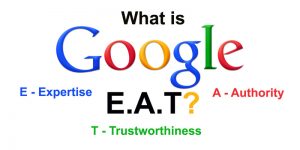
What is Google E-A-T?

Each of these terms represent a measurement of the degree to which a business is considered a leader in its field, regardless of the industry or niche that they may fall into.

Expertise” – The Oxford English Dictionary defines “expertise” as “Expert skill or knowledge in a particular field.” If you offer a service or product that you have deep knowledge about, you could be classified as an expert in that field, especially if you can demonstrate that your knowledge level matches or exceeds that of your competition.

Authoritativeness” – Authority, or “authoritativeness” — is a person or website whose content can “be trusted as being accurate or true and reliable.” Google is constantly analyzing your brand, your website, and your content to determine if it’s content is expertly written as well as the leading authority or authoritative source available.

Trustworthiness” – Trustworthiness is defined as “The ability to be relied on as honest or truthful.“ Creating a lot of content on the internet is not equivalent to being trustworthy. Google measures trust in a website based upon the backlinks it detects from other domains. The higher the trust of the “linked from” domain, the more trust is is attributed to the “linked to” domain. Google has expanded this over the past few years and is now measuring the trustworthiness of a brand or website using the same types of factors as a real person would; trust someone who has repeatedly demonstrated themselves to be trustworthy.

.

Why is E-A-T So Important for Your Web Pages?

Google states that E-A-T is among the top 3 considerations for Page Quality. Essentially, E-A-T determines a website’s value. Quality raters keep E-A-T in mind when judging how good a site or page provides what they need. They look to see if they’re getting a good online experience and if the content meets their standards. If the raters feel like a user would feel comfortable reading, sharing, and recommending the content, that earns the site a high level of E-A-T.

Think of E-A-T as the reason why users would choose your site over your competition’s. E-A-T could have a direct impact on how Google receives — and ultimately ranks — your website.

A great resource for advice on the considerations that Google takes into account when determining content quality is their search quality rater guidelines.

Make Expertise and Authoritativeness Clear

Per Google’s SEO guidelines, “Expertise and authoritativeness of a site increases its quality. Be sure that content on your site is created or edited by people with expertise in the topic. For example, providing expert or experienced sources can help users understand articles’ expertise. Representing well-established consensus in pages on scientific topics is a good practice if such consensus exists.”

Act in a way that Cultivates User Trust

Users feel comfortable visiting your site if they feel that it’s trustworthy. A site with a good reputation is trustworthy. Cultivate a reputation for expertise and trustworthiness in a specific area. Provide information about who publishes your site, provides the content, and its goals. Shopping and other financial transaction websites should have clear and satisfying customer service information to help users resolve issues. News sites should provide clear information about who is responsible for the content.

Using appropriate technologies is also important. If a shopping checkout page doesn’t have a secure connection, users cannot trust the site.

.

“Your Money or Your Life” or YMYL

So how does E-A-T affect visitors to your site?

E-A-T is closely related to what Google calls “Your Money or Your Life” (YMYL) pages.

YMYL is an acronym for “Your Money or Your Life”. YMYL content is content that can directly impact a reader’s health, finances and/or safety.

Google YMYL - Your Money Your Life

High-ranking YMYL pages will show a high level of E-A-T. This is because the safer a user feels while visiting a page, and the more relevant the content is to their search query, the more it will satisfy E-A-T. Sites that are offering genuinely helpful advice or a solution to a problem will meet E-A-T standards more readily than sites that try to game Google search.

Since E-A-T is applicable at both the page and site-level, you need to make sure that every part of your website is doing its best to meet Google’s requirements. If your pages qualify as YMYL pages, this is even more crucial.

Google says that a page or site found lacking in E-A-T is a “sufficient reason to give a page a Low-quality rating.” So if you aren’t an expert, an authority, or trustworthy, your site page could be considered low quality.


E-A-T / YMYL Questions To Ask (Google Guidelines)

  • Does the content present information in a way that makes you want to trust it, such as clear sourcing, evidence of the expertise involved, background about the author or the site that publishes it, such as through links to an author page or a site’s About page?
  • If you researched the site producing the content, would you come away with an impression that it is well-trusted or widely-recognized as an authority on its topic?
  • Is this content written by an expert or enthusiast who demonstrably knows the topic well?
  • Is the content free from easily-verified factual errors?
  • Would you feel comfortable trusting this content for issues relating to your money or your life?

.

Think of E-A-T , within the context of YMYL if applicable, as the reason why users would choose your website over your competition’s. Expertise, authoritativeness and  trustworthiness will directly impact on how Google perceives and ranks your website.

_________

For more information on ways to amplify and elevate your company’s search engine visibility, contact our Digital Marketing team.

We can walk you through the entire SEO process and pride ourselves on being responsive when answering any questions.

New, SEO

SEO 2021: Search Engine Optimization and Core Web Vitals

March 8, 2021

Search Engine Optimization and Core Web Vitals

SEO

SEO and Core Web Vitals go hand in hand in improving the quality and quantity of the traffic a website gets from organic search results. There are a number of ways that a website can achieve this, differing slightly depending on the search engine, but for the purpose of this discussion, we will be focusing on Google. Generally, the primary SEO aspects of the most important runner-up search engines (Bing & Yahoo!) are the same:

  • Create Relevant Content
  • Make the Content Accessible to Search Engines
  • Positive SEO Signals


Users go to search engines to with questions, to find out more, and your web pages might provide the answers that they’re searching for. This entails more than just writing well. When creating relevant content, it’s about picking topics and phrases that are used by your target audience.

If Google can’t understand your content, it’ll be unlikely that your page will be interpreted as relevant and Google will not recommend it. You need to demonstrate why your site’s content is highly relevant by understanding and utilizing the various search engine algorithm signals that are involved in SEO.

There’s a lot at play here. Given that there may be multiple very good and relevant search query results, how can you show that your webpage is particularly relevant and useful in providing the information that users are searching for, right now? This is where Core Web Vitals come into play. Usability plays a major role in today’s search ranking algorithms and SEO. Information is helpful, but there’s much more!

What are the Core Web vitals?

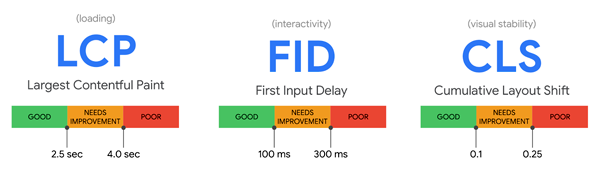
Measuring the quality of user experience has many facets. While some aspects of user experience are site and context specific, there is a common set of signals — “Core Web Vitals” — that is critical to all web experiences. Such core user experience needs include loading experience, interactivity, and visual stability of page content, and combined are the foundation of Google’s 2020-2021 Core Web Vitals.

Core Web Vitals - Overview

  • Largest Contentful Paint (LCP) measures perceived load speed and marks the point in the page load timeline when the page’s main content has likely loaded.
  • First Input Delay (FID) measures responsiveness and quantifies the experience users feel when trying to first interact with the page.
  • Cumulative Layout Shift (CLS) measures visual stability and quantifies the amount of unexpected layout shift of visible page content.


All of these metrics capture important user-centric outcomes, are field measurable, and have supporting lab diagnostic metric equivalents and tooling. For example, while Largest Contentful Paint is the topline loading metric, it is also highly dependent on First Contentful Paint (FCP) and Time to First Byte (TTFB), which remain critical to monitor and improve.

How do the Core Web Vitals play a role in SEO?

You’ve heard a lot about the Core Web Vitals today already. So this is really just a super short overview to help get you started.

The Core Web Vitals focus on three aspects affecting user experience:

  1. Loading
  2. Interactivity
  3. Stability


When it comes to data sources, Google differentiates between field data and lab test data.

Metrics Gathering

Field Data (used for search)

  • Real User Metrics or RUM data
  • Chrome User Experience Report, or CrUX
  • Based on site’s actual users from prior ~month


Field data, also called Real User Metrics or RUM data, is collected from users over the course of about a month and is based on what they experience when viewing your site. This is a part of the Chrome User Experience Report, or CrUX.

Lab Test Data

  • Approximations based on assumptions of user data
  • Useful for testing and iterative improvements


Lab tests, on the other hand, are generated on demand with testing tools in your browser or on a server using settings that try to approximate what users would see.

For search rankings, field data is used – what your site’s users have experienced over time. This makes the data more representative for your site, taking into account where your users are located and how they access your website.

The Core Web Vitals metrics are then combined with other search signals; this combination is represented as the Page Experience Ranking Factor.

Additional Search Signals include:

  1. Mobile-Friendliness
  2. Safe-Browsing
  3. HTTPS Security
  4. Compliance with Interstitial Guidelines


These have all been around for a while and there’s much written about them so we won’t go into much detail here. These signals are adjusted over time to best reflect good user experience for users. Google generally gives a six month notice before any major signal changes.

The data is split by mobile and desktop and applied appropriately for respective search rankings. When a mobile page is shown as a separate AMP URL to users, that’s what will be used  and analyzed, i.e., if you’re on a mobile page, the ranking is only affected by mobile data; the same applies for desktop.

To summarize, for search rankings, Google uses a page experience set of metrics. These include a few existing signals as well as the Core Web Vitals. Google tracks these metrics based on what users see and experience, separating the mobile and desktop experiences.

Using Search Console for Google Web Vitals

How can you use the Google Search Console to help track and improve your site’s metrics?

The Google Search Console is a free tool for site owners that gives insights into Google Search for your website. Once you’ve verified ownership of your website and allowed a bit of time for the collection of all the metrics, it’s time to head over to the Core Web Vitals Report.

Using Search Console for Google Web Vitals


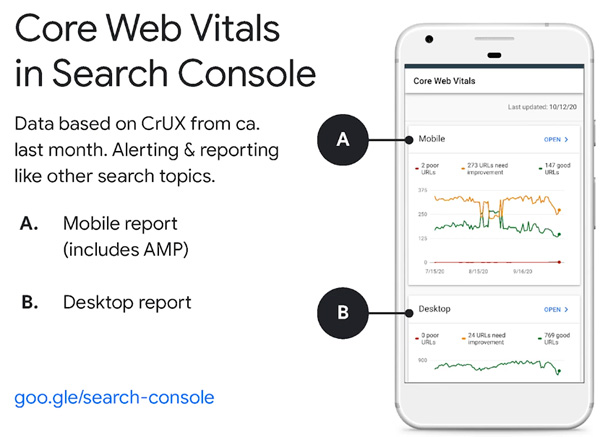
In the Core Web Vitals report, you’ll see graphs for mobile and desktop showing how a relevant sample of your site’s pages score. This sampling and the scoring is based on the Chrome user experience report data. That’s the field data collected over time. As a result, any changes that you make on your website will take about a month to be reflected here.

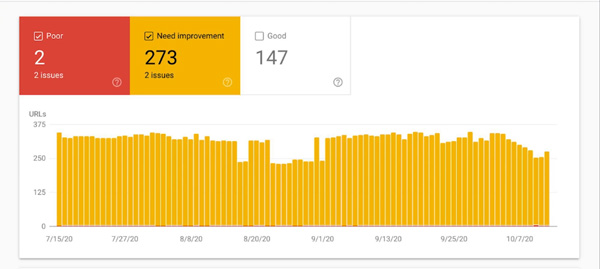
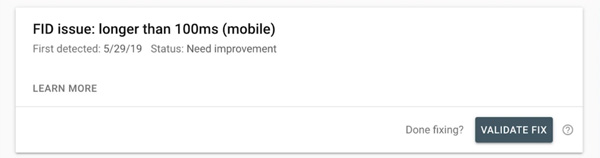
Clicking through to one of these reports, you see a graph of the total number of URLs tracked and can see the individual issues flagged.

Core Web Vitals in Search Console

Core Web Vitals in Search Console


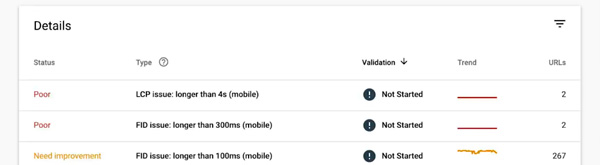
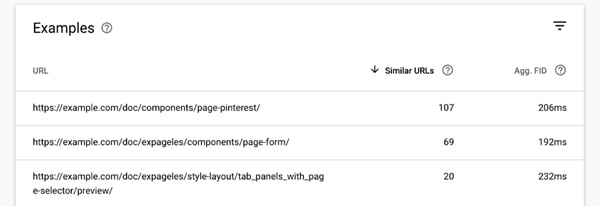
Drilling down, into one of these issues, you’ll see a similar graph on top, with a list of sample URLs for the respective issue type below.

Issue Drill-Down in Search Console

Issue Drill-Down in Search Console


Bear in mind that these search console reports are based on a sampling of field data, consequently not all of your website’s URLs will be listed here. It’s usually useful to focus on the larger issues across both the “poor” and “needs improvement” categories. Google tries to recognize patterns, such as shared templates and group those URLs together; fixing a major issue once can improve large segments of your website.

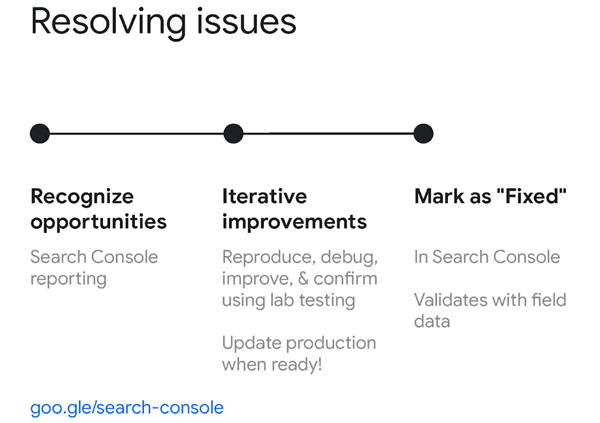
A good approach to improving these issues is to take a larger “issue type” and to work on resolving it. Upon identifying the issue, the first step is generally to reproduce the issue locally or within a testing environment.


Resolving Issues in Search Console


If addressing bigger issues is not possible, it is recommended to narrow down the issues using various tools and scripts available elsewhere. Once you’ve reproduced the issue, you can work to improve the vitals. Sometimes you may notice that other Google products or services are slowing down your pages. Google Search doesn’t give any special treatment to these, just like users generally won’t care why your pages offer a bad user experience. Treat embeds from Google, just like you would treat any other embedded resource.

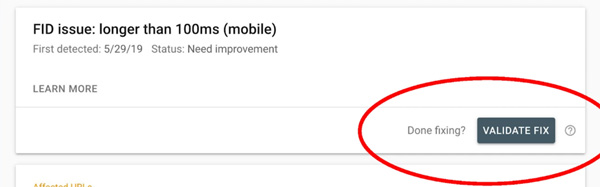
Once your live website is updated, you can notify Search Console that the issue is fixed. This is done using the appropriate drill-down report and clicking the Validate Fix button at the top. Search Console will then begin a review of the flagged URLs and report on how your improvements turned out over time.

Resolving Issues in Search Console


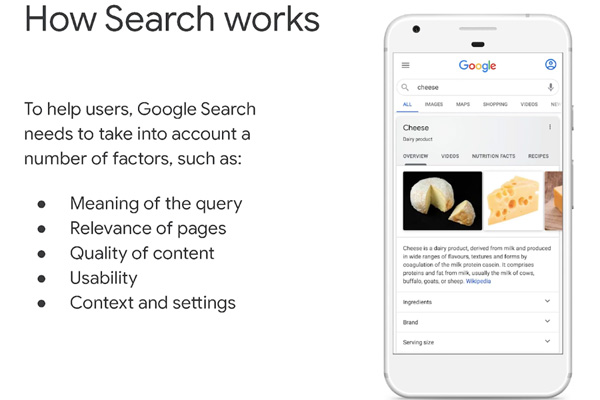
As mentioned earlier, there’s more to SEO than just page experience. Some of the factors are listed here. When determining search rankings, Google tries to weigh these factors appropriately. In general, Google prioritizes pages with the best information overall, even if some aspects of page experience are subpar.

How Search Works


A good page experience doesn’t override having great relevant content. For example, if someone is searching for your company’s name, it would be expected to show your company’s website, even if it’s slow or otherwise provides a subpar page experience. In cases where there are multiple pages that have similar content, page experience becomes much more important for visibility in Search. It’s not the only factor. And of course there’s much more to a website than just Search.

How Search Works

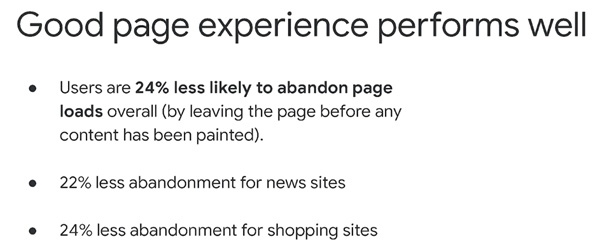
Google finds that when a site provides a good page experience, it generally performs well with users as well. For example, according to Google, users are 24% less likely to abandon page loads overall, 22% less abandonment for new sites and 24% less abandonment for shopping sites. There are a number of web page changes/fixes that can show this level of improvement for online businesses, and results like these are part of the reason Google prioritizes the web vitals metrics.

Core Web Vitals as a 2021 Ranking Factor

Google has announced that the Core Web Vitals will become a ranking factor this year. They have also committed to an additional notification six months before the specific date on which it will happen.

The switch to the Mobile First Index was recently postponed from September 2020 to March 2021. Therefore it’s likely that the Core Web Vitals will be made a ranking factor in the second half of 2021.

In any case, it is not advisable to postpone addressing Core Web Vital metrics on your site for too long. While Google is driving improvements that will also help you outside of pure SEO: faster, user-friendly websites, etc., improvements to the Core Web Vitals are technically complex and are likely to take time. In addition, more time will pass before the effects of these improvements are seen in the field data. Bottom line… SEO, with attention to Web Vitals, is definitely the way to go as far as improving your website’s page experience in 2021.

_________

For more information on ways to amplify and elevate your company’s search engine visibility, contact our Digital Marketing team.

We can walk you through the entire SEO process and pride ourselves on being responsive when answering any questions.